
7. Salvation of Trnavarta
7 / Salvation of Tåëävarta
The Supreme Personality of Godhead, Kåñëa, is always full of six opulences--namely complete wealth, complete strength, complete fame, complete knowledge, complete beauty and complete renunciation. The Lord appears in different complete, eternal forms of incarnation. The conditioned soul has immense opportunity to hear about the transcendental activities of the Lord in these different incarnations. In the Bhagavad-gétä it is said, janma karma ca me divyam. The pastimes and activities of the Lord are not material; they are beyond the material conception. But the conditioned soul can benefit by hearing such uncommon activities. Hearing is an opportunity to associate with the Lord; to hear His activities is to evolve to the transcendental nature--simply by hearing. The conditioned soul has a natural aptitude to hear something about other conditioned souls in the form of fiction, drama and novel. That inclination to hear something about others may be utilized in hearing the pastimes of the Lord. Then one can immediately evolve to his transcendental nature. Kåñëa's pastimes are not only beautiful; they are also very pleasing to the mind.
If someone takes advantage of hearing the pastimes of the Lord, the material contamination of dust, accumulated in the heart due to long association with material nature, can be immediately cleansed. Lord Caitanya also instructed that simply by hearing the transcendental name of Lord Kåñëa, one can cleanse the heart of all material contamination. There are different processes for self-realization, but this process of devotional service--of which hearing is the most important function--when adopted by any conditioned soul, will automatically cleanse him of the material contamination and enable him to realize his real constitutional position. Conditional life is due to this contamination only, and as soon as it is cleared off, then naturally the dormant function of the living entity--rendering service to the Lord--awakens. By developing his eternal relationship with the Supreme Lord, one becomes eligible to create friendship with the devotees. Mahäräja Parékñit recommended, from practical experience, that everyone try to hear about the transcendental pastimes of the Lord. This Kåñëa treatise is meant for that purpose, and the reader may take advantage in order to attain the ultimate goal of human life.
The Lord, out of His causeless mercy, descends on this material world and displays His activities just like an ordinary man. Unfortunately the impious entities or the atheistic class of men consider Kåñëa to be an ordinary man like themselves, and so they deride Him. This is condemned in the Bhagavad-gétä by the Lord Himself when He says, "Avajänanti mäà müòhäù." The müòhas, or the rascals, take Kåñëa to be an ordinary man or a slightly more powerful man; out of their great misfortune, they cannot accept Him as the Supreme Personality of Godhead. Sometimes such unfortunate persons misrepresent themselves as incarnations of Kåñëa without referring to the authorized scriptures.
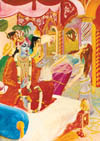
When Kåñëa grew up a little more, He began to turn Himself backside up; He did not merely lie down on His back. And another function was observed by Yaçodä and Nanda Mahäräja: Kåñëa's first birthday. They arranged for Kåñëa's birthday ceremony, which is still observed by all followers of the Vedic principles. (Kåñëa's birthday ceremony is observed in India by all Hindus, irrespective of different sectarian views.) All the cowherd men and women were invited to participate, and they arrived in jubilation. A nice band played, and the people assembled enjoyed it. All the learned brähmaëas were invited, and they chanted Vedic hymns for the good fortune of Kåñëa. During the chanting of the Vedic hymns and playing of the bands, Kåñëa was bathed by mother Yaçodä. This bathing ceremony is technically called abhiñeka, and even today this is observed in all the temples of Våndävana as Janmäñöamé Day, or the birthday anniversary of Lord Kåñëa.
On this occasion, mother Yaçodä arranged to distribute a large quantity of grains, and first-class cows decorated with golden ornaments were made ready to be given in charity to the learned, respectable brähmaëas. Yaçodä took her bath and dressed herself nicely, and taking child Kåñëa, duly dressed and bathed, on her lap, she sat down to hear the Vedic hymns chanted by the brähmaëas. While listening to the chanting of the Vedic hymns, the child appeared to be falling asleep, and therefore mother Yaçodä very silently laid Him down on the bed. Being engaged in receiving all the friends, relatives and residents of Våndävana on that holy occasion, she forgot to feed the child milk. He was crying, being hungry, but mother Yaçodä could not hear Him cry because of the various noises. The child, however, became angry because He was hungry and His mother was not paying attention to Him. So He lifted His legs and began to kick His lotus feet just like an ordinary child. Baby Kåñëa had been placed underneath a hand-driven cart, and while He was kicking His legs, He accidentally touched the wheel of the cart, and it collapsed. Various kinds of utensils and brass and metal dishes had been piled up in the handcart, and they all fell down with a great noise. The wheel of the cart separated from the axle, and the spokes of the wheel were all broken and scattered hither and thither. Mother Yaçodä and all the gopés, as well as Mahäräja Nanda and the cowherd men, were astonished as to how the cart could have collapsed by itself. All the men and women who were assembled for the holy function crowded around and began to suggest how the cart might have collapsed. No one could ascertain the cause, but some small children who were entrusted to play with baby Kåñëa informed the crowd that it was due to Kåñëa's striking His feet against the wheel. They assured the crowd that they had seen how it happened with their own eyes, and they strongly asserted the point. Some were listening to the statement of the small children, but others said, "How can you believe the statements of these children?" The cowherd men and women could not understand that the all-powerful Personality of Godhead was lying there as a baby, and He could do anything. Both the possible and impossible were in His power. While the discussion was going on, baby Kåñëa cried. Without remonstration, mother Yaçodä picked the child up on her lap and called the learned brähmaëas to chant holy Vedic hymns to counteract the evil spirits. At the same time she allowed the baby to suck her breast. If a child sucks the mother's breast nicely, it is to be understood that he is out of all danger. After this, all the stronger cowherd men put the broken cart in order, and all the scattered things were set up nicely as before. The brähmaëas thereafter began to offer oblations to the sacrificial fire with yogurt, butter, kuça grass, and water. They worshiped the Supreme Personality of Godhead for the good fortune of the child.
The brähmaëas who were present at that time were all qualified because they were not envious; they never indulged in untruthfulness, they were never proud, they were nonviolent, and they never claimed any false prestige. They were all bona fide brähmaëas, and there was no reason to think that their blessing would be useless. With firm faith in the qualified brähmaëas, Nanda Mahäräja took his child on his lap and bathed Him with water mixed with various herbs while the brähmaëas chanted hymns from the Åk, Yajus and Säma Vedas.
It is said that without being a qualified brähmaëa, one should not read the mantras of the Vedas. Here is the proof that the brähmaëas were qualified with all the brahminical symptoms. Mahäräja Nanda also had full faith in them. Therefore they were allowed to perform the ritualistic ceremonies by chanting the Vedic mantras. There are many different varieties of sacrifices recommended for different purposes, but the mantras are all to be chanted by qualified brähmaëas. And because in this age of Kali such qualified brähmaëas are not available, all Vedic ritualistic sacrifices are forbidden. Çré Caitanya Mahäprabhu has therefore recommended only one kind of sacrifice in this age--namely saìkértana yajïa, or simply chanting the mahämantra, Hare Kåñëa, Hare Kåñëa, Kåñëa Kåñëa, Hare Hare, Hare Räma, Hare Räma, Räma Räma, Hare Hare.
As the brähmaëas chanted the Vedic hymns and performed the ritualistic ceremonies for the second time, Nanda Mahäräja again gave huge quantities of grains and many cows to them. All the cows which were given in charity were covered with nice gold-embroidered garments, and their horns were bedecked with golden rings; their hooves were covered with silver plate, and they wore garlands of flowers. He gave so many cows just for the welfare of his wonderful child, and the brähmaëas in return bestowed their heartfelt blessing. And the blessings offered by the able brähmaëas were never to be baffled.
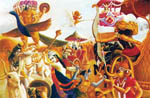
One day, shortly after this ceremony, when mother Yaçodä was patting her baby on her lap, the baby felt too heavy, and being unable to carry Him, she unwillingly placed Him on the ground. After a while, she became engaged in household affairs. At that time, one of the servants of Kaàsa, known as Tåëävarta, as instructed by Kaàsa, appeared there in the shape of a whirlwind. He picked the child up on his shoulders and raised a great dust storm all over Våndävana. Because of this, everyone's eyes became covered within a few moments, and the whole area of Våndävana became densely dark so that no one could see himself or anyone else. During this great catastrophe, mother Yaçodä could not see her baby, who was taken away by the whirlwind, and she began to cry very piteously. She fell down on the ground exactly like a cow who has just lost her calf. When mother Yaçodä was so piteously crying, all the cowherd women immediately came and began to look for the baby, but they were disappointed and could not find Him. The Tåëävarta demon who took baby Kåñëa on his shoulder went high in the sky, but the baby assumed such a weight that suddenly he could not go any further, and he had to stop his whirlwind activities. Baby Kåñëa made Himself heavy and began to weigh down the demon. The Lord caught hold of his neck. Tåëävarta felt the baby to be as heavy as a big mountain, and he tried to get out of His clutches, but he was unable to do so, and his eyes popped out from their sockets. Crying very fiercely, he fell down to the ground of Våndävana and died. The demon fell exactly like Tripuräsura, who was pierced by the arrow of Lord Çiva. He hit the stone ground, and his limbs were smashed. His body became visible to all the inhabitants of Våndävana.
When the gopés saw the demon killed and child Kåñëa very happily playing on his body, they immediately picked Kåñëa up with great affection. The cowherd men and women became very happy to get back their beloved child Kåñëa. At that time they began to talk about how wonderful it was that the demon took away the child to devour Him but could not do so; instead he fell down dead. Some of them supported the situation: "This is proper because those who are too sinful die from their sinful reactions, and child Kåñëa is pious; therefore He is saved from all kinds of fearful situations. And we too must have performed great sacrifices in our previous lives, worshiping the Supreme Personality of Godhead, giving great wealth in charity and acting philanthropically for the general welfare of men. Because of such pious activities, the child is saved from all danger."
The gopés assembled there spoke among themselves: "What sort of austerities and penances we must have undergone in our previous lives! We must have worshiped the Supreme Personality of Godhead, offered different kinds of sacrifices, made charities and performed many welfare activities for the public such as growing banyan trees and excavating wells. As a result of these pious activities, we have got back our child, even though He was supposed to be dead. Now He has come back to enliven His relatives." After observing such wonderful happenings, Nanda Mahäräja began to think of the words of Vasudeva again and again.
After this incident, when Yaçodä once was nursing her child and patting Him with great affection, there streamed a profuse supply of milk from her breast, and when she opened the mouth of the child with her fingers, she suddenly saw the universal manifestation within His mouth. She saw within the mouth of Kåñëa the whole sky, including the luminaries, stars in all directions, the sun, moon, fire, air, seas, islands, mountains, rivers, forests, and all other movable and immovable entities. Upon seeing this, mother Yaçodä's heart began to throb, and she murmured within herself, "How wonderful this is!" She could not express anything, but simply closed her eyes. She was absorbed in wonderful thoughts. Kåñëa's showing the universal form of the Supreme Personality of Godhead, even when lying down on the lap of His mother, proves that the Supreme Personality of Godhead is always the Supreme Personality of Godhead, whether He is manifested as a child on the lap of His mother or as a charioteer on the battlefield of Kurukñetra. The concoction of the impersonalist, that one can become God by meditation or by some artificial material activities, is herewith declared false. God is always God in any condition or status, and the living entities are always the parts and parcels of the Supreme Lord. They can never be equal to the inconceivable supernatural power of the Supreme Personality of Godhead.
Thus ends the Bhaktivedanta purport of the Seventh Chapter of Kåñëa, "Salvation of Tåëävarta."


Purchase the Book
(1970 Edition, 2 Volumes, 400 pages each. Hard Cover, 70 color plates, 6"x9")
(1970 Edition, 2 Volumes, 400 pages each. Hard Cover, 70 color plates, 6"x9")